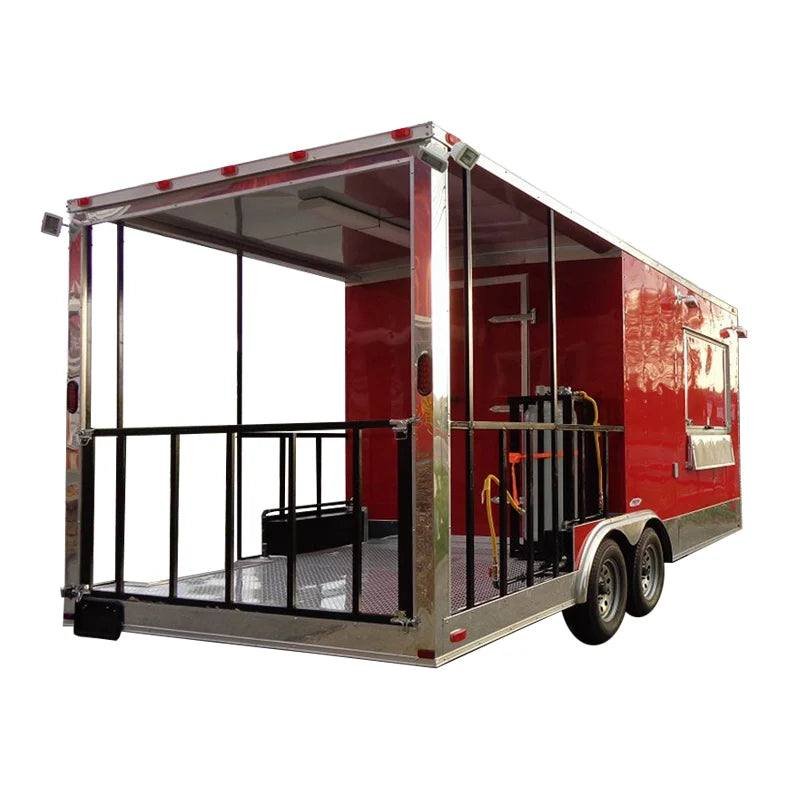
For most first-time owners, how much a food trailer costs is the question that decides everything else – the menu, the loan, and the timeline. The honest answer is a wide range, because a bare concession trailer and a custom BBQ rig with a built-in smoker are very different machines. This guide breaks the cost down by type, by condition, and by the hidden extras that catch buyers off guard.
The biggest driver of price is what the trailer is built to cook. These are the typical starting prices we see across our inventory, from the most affordable to the most equipment-heavy builds.
| Trailer type | Typical starting price | Why |
|---|---|---|
| BBQ & smoker trailers | from ~$2,600 | An open pit on a frame needs little finishing. |
| Concession trailers | from ~$6,800 | Enclosed cabin, serving window, and sinks. |
| Catering trailers | from ~$8,700 | Larger mobile kitchens for high volume. |
| Coffee trailers | from ~$15,000 | Espresso gear and water systems add cost. |
| Pizza trailers | from ~$19,000 | Ovens and hoods are expensive to install. |
| Ice cream trailers | from ~$21,000 | Freezers and soft-serve machines drive price. |
Browse every option in the full food trailer lineup, where you can filter by type and see real photos and prices on each unit.
A brand-new custom food trailer is built to your exact menu and finished to current health codes, but you pay for that with a higher price and a wait of weeks or months. A used trailer costs far less and is ready now, though you should budget for inspection, a deep clean, and possibly new gaskets or a fresh certification. For most new owners, a clean used or refurbished trailer is the fastest way to start earning while keeping the upfront cost down.
A food trailer almost always costs less than a comparable food truck, because there is no engine, transmission, or vehicle chassis to buy and maintain. You tow a trailer with a truck you may already own, you can unhitch and leave it on site, and repairs are cheaper because it is a kitchen on wheels, not a vehicle. The trade-off is mobility: a food truck drives itself between spots, while a trailer needs a tow vehicle each time you move. For owners who park at steady locations, the lower cost of a trailer is usually the better deal.
The sticker price is only part of the budget. Plan for a health-department permit and inspection, a business license, and commissary or commercial-kitchen requirements that vary by city. Equipment that touches food should meet sanitation standards – look for the NSF mark. Add insurance, propane or generator power, a point-of-sale and card reader, initial inventory, and a tow vehicle if you do not already have one. A realistic rule of thumb is to set aside 15 to 25 percent of the trailer price for these startup extras.
Adding it up: a lean start with a used concession trailer and basic permits can come in under $12,000, a solid mid-range BBQ or catering setup lands around $20,000 to $40,000, and a fully custom new build with premium equipment can pass $100,000. The smartest first move is to match the trailer to your actual menu – no more, no less – and buy used where the equipment is already what you need.
Yes. A food trailer is usually 40 to 60 percent cheaper than a comparable food truck because there is no vehicle, engine, or transmission to buy and maintain. You tow it with a truck instead.
Open BBQ and smoker trailers are the most affordable, starting around $2,600, because they need little finishing. Basic used concession trailers start near $6,800.
Used food trailers commonly run from about $6,800 for a basic concession unit to $35,000 for a larger, well-equipped trailer, depending on size and the cooking gear inside.
Beyond the trailer, budget for permits and inspection, a business license, insurance, propane or a generator, a point-of-sale system, initial inventory, and a tow vehicle – often 15 to 25 percent of the trailer price.
Browse our full catalog of commercial vending machines, shipped free across the U.S. with install included.
For most first-time owners, how much a food trailer costs is the question that decides everything else – the menu, the loan, and the timeline. The honest answer is a wide range, because a bare concession trailer and a custom BBQ rig with a built-in smoker are very different machines. This guide breaks the cost down by type, by condition, and by the hidden extras that catch buyers off guard.
The biggest driver of price is what the trailer is built to cook. These are the typical starting prices we see across our inventory, from the most affordable to the most equipment-heavy builds.
| Trailer type | Typical starting price | Why |
|---|---|---|
| BBQ & smoker trailers | from ~$2,600 | An open pit on a frame needs little finishing. |
| Concession trailers | from ~$6,800 | Enclosed cabin, serving window, and sinks. |
| Catering trailers | from ~$8,700 | Larger mobile kitchens for high volume. |
| Coffee trailers | from ~$15,000 | Espresso gear and water systems add cost. |
| Pizza trailers | from ~$19,000 | Ovens and hoods are expensive to install. |
| Ice cream trailers | from ~$21,000 | Freezers and soft-serve machines drive price. |
Browse every option in the full food trailer lineup, where you can filter by type and see real photos and prices on each unit.
A brand-new custom food trailer is built to your exact menu and finished to current health codes, but you pay for that with a higher price and a wait of weeks or months. A used trailer costs far less and is ready now, though you should budget for inspection, a deep clean, and possibly new gaskets or a fresh certification. For most new owners, a clean used or refurbished trailer is the fastest way to start earning while keeping the upfront cost down.
A food trailer almost always costs less than a comparable food truck, because there is no engine, transmission, or vehicle chassis to buy and maintain. You tow a trailer with a truck you may already own, you can unhitch and leave it on site, and repairs are cheaper because it is a kitchen on wheels, not a vehicle. The trade-off is mobility: a food truck drives itself between spots, while a trailer needs a tow vehicle each time you move. For owners who park at steady locations, the lower cost of a trailer is usually the better deal.
The sticker price is only part of the budget. Plan for a health-department permit and inspection, a business license, and commissary or commercial-kitchen requirements that vary by city. Equipment that touches food should meet sanitation standards – look for the NSF mark. Add insurance, propane or generator power, a point-of-sale and card reader, initial inventory, and a tow vehicle if you do not already have one. A realistic rule of thumb is to set aside 15 to 25 percent of the trailer price for these startup extras.
Adding it up: a lean start with a used concession trailer and basic permits can come in under $12,000, a solid mid-range BBQ or catering setup lands around $20,000 to $40,000, and a fully custom new build with premium equipment can pass $100,000. The smartest first move is to match the trailer to your actual menu – no more, no less – and buy used where the equipment is already what you need.
Yes. A food trailer is usually 40 to 60 percent cheaper than a comparable food truck because there is no vehicle, engine, or transmission to buy and maintain. You tow it with a truck instead.
Open BBQ and smoker trailers are the most affordable, starting around $2,600, because they need little finishing. Basic used concession trailers start near $6,800.
Used food trailers commonly run from about $6,800 for a basic concession unit to $35,000 for a larger, well-equipped trailer, depending on size and the cooking gear inside.
Beyond the trailer, budget for permits and inspection, a business license, insurance, propane or a generator, a point-of-sale system, initial inventory, and a tow vehicle – often 15 to 25 percent of the trailer price.